Haberler · 9 Kasım 2026
A Robot Builds in Space for the First Time
Bir robot uzayda ilk kez kendi başına inşaat yaptı
Caltech'in ASTRA görevinde, yörüngedeki küçük bir robot insan yardımı olmadan bir yapının bir bölümünü inşa etti. Amaç gelecekte uzayda dev antenler ve teleskoplar kurmak.
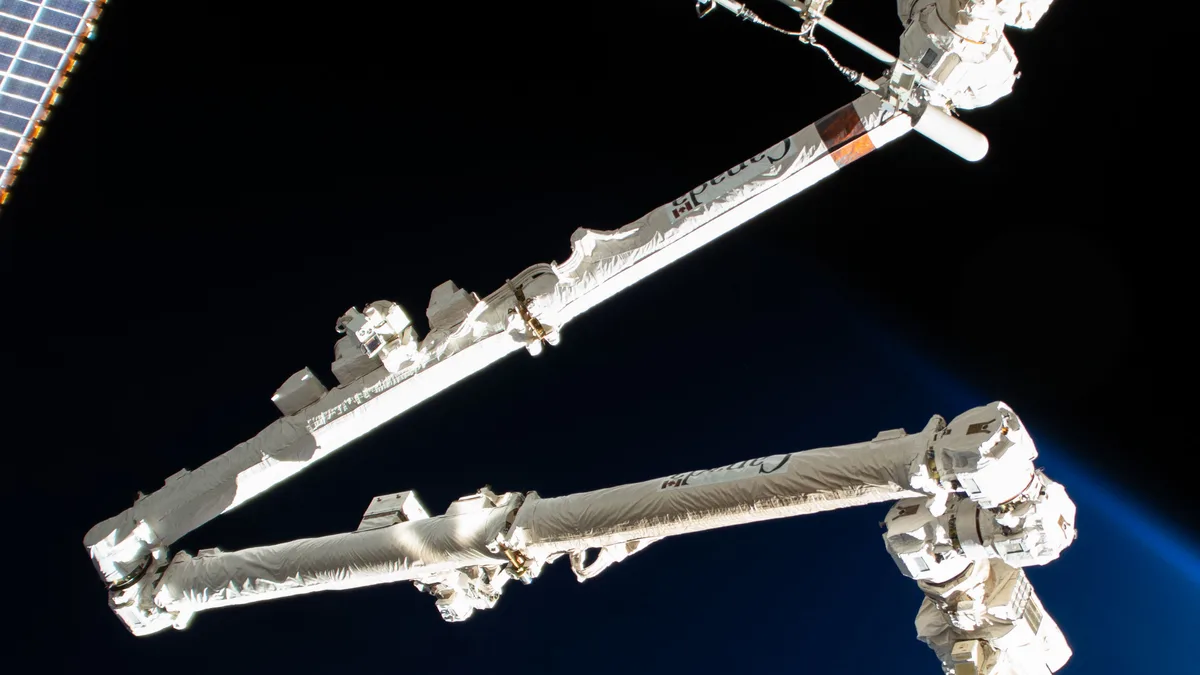
ISS üzerindeki Canadarm2 robot kolu (temsilî görsel; ASTRA değil) · Fotoğraf: NASA · Public domain
Level 1 · Başlangıç · A1–A2
Metni dinle
Altı çizili kelimelere dokun!
Big things in space, like , must fit inside a first. That is a big problem. What if robots could build them in space?
Teleskoplar gibi uzaydaki büyük şeylerin önce bir roketin içine sığması gerekir. Bu büyük bir sorun. Peki robotlar onları uzayda inşa edebilseydi?
Scientists from Caltech, a university in the USA, sent a small robot into space in March 2026. Its job was to part of an all by itself.
ABD'de bir üniversite olan Caltech'ten bilim insanları Mart 2026'da küçük bir robotu uzaya gönderdi. Görevi bir antenin bir parçasını tamamen kendi başına inşa etmekti.
The robot has an . It took thin and metal pieces and put them together. There were no to help it.
Robotun bir kolu var. İnce tüpleri ve metal parçaları aldı ve birleştirdi. Ona yardım edecek astronot yoktu.
The robot did not finish the whole antenna, but it built one new part. The scientists are very happy. In the future, robots may build things in space.
Robot bütün anteni bitirmedi ama yeni bir parça inşa etti. Bilim insanları çok mutlu. Gelecekte robotlar uzayda dev şeyler inşa edebilir.
Gramer ipucu
What if …?
What if + geçmiş zaman: Hayalî bir olasılığı sormak için kullanılır: “Peki ya … -sa?”.
Metinden:
What if robots could build them in space?
Başka örnekler:
- What if we had more time?Peki ya daha çok zamanımız olsaydı?
- What if it rains tomorrow?Peki ya yarın yağmur yağarsa?
Bu metnin kelimeleri
- telescope isim teleskop The telescope shows distant stars.
- rocket isim roket The rocket went up into space.
- build fiil inşa etmek, yapmak They want to build a new school.
- antenna isim anten The radio has a long antenna.
- arm isim kol He broke his arm.
- tube isim tüp, boru Water goes through this tube.
- astronaut isim astronot She wants to be an astronaut.
- huge sıfat devasa, kocaman They live in a huge house.
Anladın mı? Mini quiz
-
What is the big problem with big things in space?
Bir roketin içine sığmaları gerekir.
-
When did the robot go into space?
Mart 2026'da.
-
Who helped the robot?
Kimse; kendi başına çalıştı.
-
Did the robot finish the whole antenna?
Hayır ama yeni bir parça inşa etti.
Level 2 · Orta · B1
Altı çizili kelimelere dokun!
For the first time, a robot has built part of a structure in , according to engineers at Caltech. The experiment, called ASTRA, could be an important step towards building giant telescopes and antennas directly in space.
Caltech'teki mühendislere göre bir robot ilk kez yörüngede bir yapının bir bölümünü kendi başına inşa etti. ASTRA adlı deney, dev teleskopları ve antenleri doğrudan uzayda inşa etmeye yönelik önemli bir adım olabilir.
Today, anything we send into space must fit inside the nose of a rocket. This the size of telescopes and solar panels. The Caltech team, by the US research agency DARPA, wants robots to much larger structures after , without astronauts.
Bugün uzaya gönderdiğimiz her şeyin bir roketin burun kısmına sığması gerekiyor. Bu da teleskopların ve güneş panellerinin boyutunu sınırlıyor. ABD araştırma ajansı DARPA tarafından finanse edilen Caltech ekibi, robotların fırlatmadan sonra, astronotlar olmadan çok daha büyük yapıları monte etmesini istiyor.
ASTRA was launched on 30 March 2026 on a SpaceX rocket. Inside a box of about one cubic metre, a robotic arm took tubes and connectors from small dispensers and joined them into a . The goal was an antenna 1.4 metres wide made of 11 sections. The robot started with two ready-made sections and built a third in orbit.
ASTRA, 30 Mart 2026'da bir SpaceX roketiyle fırlatıldı. Yaklaşık bir metreküplük bir kutunun içinde robotik bir kol küçük dağıtıcılardan tüpleri ve bağlantı parçalarını aldı ve bunları bir çerçevede birleştirdi. Hedef, 11 bölümden oluşan 1,4 metre genişliğinde bir antendi. Robot hazır iki bölümle başladı ve yörüngede üçüncüsünü inşa etti.
Technical problems meant the full antenna was not completed before the mission's end, planned for December. Still, the team says the result proves the method works. One day, similar robots could build structures hundreds of metres, or even kilometres, .
Teknik sorunlar nedeniyle tam anten, aralıkta bitmesi planlanan görev sona ermeden tamamlanamadı. Yine de ekip, sonucun yöntemin işe yaradığını kanıtladığını söylüyor. Bir gün benzer robotlar yüzlerce metre, hatta kilometrelerce genişlikte yapılar inşa edebilir.
Gramer ipucu
according to …
according to + kaynak: “… -e göre”. Haber dilinde bilginin kaynağını belirtmek için çok kullanılır.
Metinden:
according to engineers at Caltech
Başka örnekler:
- According to the news, it will snow tomorrow.Haberlere göre yarın kar yağacak.
- According to my doctor, I need more sleep.Doktoruma göre daha çok uykuya ihtiyacım var.
Bu metnin kelimeleri
- autonomously zarf kendi başına, özerk olarak The car can drive autonomously.
- orbit isim yörünge The satellite is in orbit around the Earth.
- limit fiil sınırlamak We must limit our spending.
- fund fiil finanse etmek The project is funded by the EU.
- assemble fiil monte etmek, birleştirmek I assembled the new shelves myself.
- launch fiil fırlatmak They will launch the rocket next week.
- frame isim çerçeve, iskelet The house has a steel frame.
- across zarf genişliğinde, çapında The crater is two kilometres across.
Anladın mı? Mini quiz
-
What is ASTRA?
Bir robotun yörüngede inşaat yaptığı bir deney.
-
Who funded the Caltech team?
DARPA.
-
How many sections did the robot build in orbit?
Bir; üçüncü bölümü.
-
What does the team say the result proves?
Yöntemin işe yaradığını.
Level 3 · İleri · B2
Altı çizili kelimelere dokun!
Every large object humanity has placed in space shares one : it first had to fit inside a rocket fairing. Telescopes are folded, antennas are packed like origami, and their final size is limited by the dimensions of the launch vehicle. A Caltech experiment has now demonstrated a way around that , with a robot autonomously assembling part of a structure in orbit.
İnsanlığın uzaya yerleştirdiği her büyük nesnenin ortak bir kısıtı var: Önce bir roket burun kapağının içine sığması gerekiyordu. Teleskoplar katlanıyor, antenler origami gibi paketleniyor ve nihai boyutları fırlatma aracının ölçüleriyle sınırlı kalıyor. Caltech'teki bir deney şimdi bu darboğazı aşmanın bir yolunu, yörüngede bir yapının bir bölümünü kendi başına monte eden bir robotla gösterdi.
The mission, ASTRA (Autonomous In-Space Reflector Assembly), was funded through DARPA's NOM4D programme and launched on 30 March 2026 aboard a SpaceX rideshare flight. Housed in a of roughly one cubic metre, a robotic arm drew composite tubes and aluminium connectors from motorised dispensers and joined them into repeating sections, or bays, of a . The target was a 1.4-metre reflector antenna of 11 bays, its surface a thin perforated film held in tension by cable nets.
ASTRA (Otonom Uzayda Gerilimli Reflektör Montajı) görevi, DARPA'nın NOM4D programı aracılığıyla finanse edildi ve 30 Mart 2026'da paylaşımlı bir SpaceX uçuşuyla fırlatıldı. Kabaca bir metreküplük bir faydalı yükün içine yerleştirilmiş robotik bir kol, motorlu dağıtıcılardan kompozit tüpler ve alüminyum bağlantılar çekerek bunları bir kafes yapının tekrar eden bölümlerinde, yani bölmelerinde birleştirdi. Hedef, yüzeyi kablo ağlarıyla gergin tutulan ince, delikli bir filmden oluşan, 11 bölmeli, 1,4 metrelik bir reflektör antendi.
The payload began with two pre-assembled bays and built a third in orbit. Technical problems and the short communication windows available each day prevented the team from completing the full antenna; engineers diagnosed faults using a kept on the ground and sent revised instructions in brief contacts. Nevertheless, the researchers, led by aerospace professor Sergio Pellegrino, present the build as proof that the concept works.
Faydalı yük önceden monte edilmiş iki bölmeyle başladı ve yörüngede üçüncüsünü inşa etti. Teknik sorunlar ve her gün kullanılabilen kısa iletişim pencereleri ekibin anteni tamamlamasını engelledi; mühendisler arızaları yerde tutulan bir yedek uçuş modeliyle teşhis etti ve kısa bağlantılarda güncellenmiş talimatlar gönderdi. Yine de havacılık profesörü Sergio Pellegrino liderliğindeki araştırmacılar bu kısmi yapımı kavramın işe yaradığının kanıtı olarak sunuyor.
The long-term ambition is considerable. Structures hundreds of metres or even kilometres across could support vast space telescopes, communication antennas and solar power arrays capable of energy to Earth. ASTRA built only one bay, but it may mark the moment construction in space stopped being science fiction.
Uzun vadeli hedef oldukça büyük. Yüzlerce metre, hatta kilometrelerce genişlikteki yapılar devasa uzay teleskoplarını, iletişim antenlerini ve enerjiyi Dünya'ya ışınlayabilecek güneş enerjisi dizilerini destekleyebilir. ASTRA yalnızca bir bölme inşa etti ama uzayda inşaatın bilim kurgu olmaktan çıktığı anı işaret ediyor olabilir.
Gramer ipucu
stop + V-ing
stop + V-ing: bir şeyi yapmayı/olmayı bırakmak. stop to + V1 ise “bir şey yapmak için durmak” demektir.
Metinden:
construction in space stopped being science fiction
Başka örnekler:
- He stopped smoking last year.Geçen yıl sigarayı bıraktı.
- We stopped to buy some water.Su almak için durduk.
Bu metnin kelimeleri
- constraint isim kısıt, sınırlama Money is our main constraint.
- bottleneck isim darboğaz The narrow bridge is a bottleneck.
- payload isim faydalı yük (uzay aracı) The rocket carried a satellite as its payload.
- truss isim kafes kiriş, kafes yapı The roof is supported by a steel truss.
- tension isim gerilim, gerginlik Keep the rope under tension.
- flight spare isim yedek uçuş modeli Engineers tested the fix on the flight spare.
- partial sıfat kısmi It was only a partial success.
- beam fiil ışınlamak, yaymak The satellite beams signals to Earth.
Anladın mı? Mini quiz
-
What constraint do large space objects share?
Roket burun kapağının içine sığmaları gerekir.
-
What does ASTRA stand for?
Autonomous In-Space Tensioned Reflector Assembly.
-
How did engineers diagnose problems?
Yerde tutulan yedek uçuş modeliyle.
-
What might large structures in space support in the future?
Enerjiyi Dünya'ya ışınlayan güneş enerjisi dizileri.