Yemek & İçecek · Metin 61
The Story of Baklava
Baklavanın hikâyesi
İnce yufka, fıstık, şerbet... Baklavanın kökeni neden tartışmalı, Antep baklavası nasıl AB koruması aldı ve saray mutfağında baklavanın yeri ne?
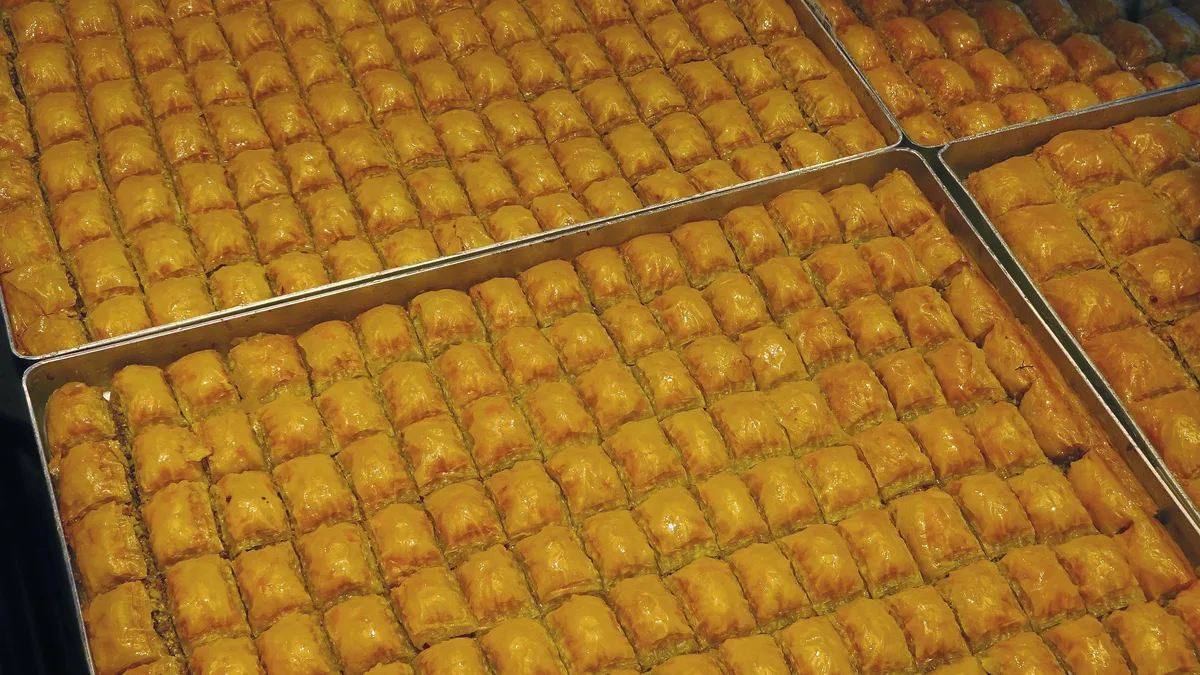
İstanbul'da bir fırında baklava tepsileri · Fotoğraf: Benreis · CC BY-SA 4.0
Level 1 · Başlangıç · A1–A2
Metni dinle
Altı çizili kelimelere dokun!
Baklava is one of Turkey's most famous . It is made with very thin of dough, nuts and sweet .
Baklava Türkiye'nin en ünlü tatlılarından biri. Çok ince yufka katları, kuruyemiş ve tatlı şerbetle yapılır.
Making baklava is not easy. A good baklava master can roll the dough so thin that you can read a newspaper through it! There are often about 40 layers in one .
Baklava yapmak kolay değildir. İyi bir baklava ustası yufkayı o kadar ince açabilir ki içinden gazete okuyabilirsin! Bir tepside çoğu zaman yaklaşık 40 kat vardır.
The most famous baklava comes from Gaziantep. People there use green from their own region. In 2013, Gaziantep baklava got a special name in the European Union.
En ünlü baklava Gaziantep'ten gelir. Oradaki insanlar kendi yörelerinin yeşil fıstığını kullanır. 2013'te Gaziantep baklavası Avrupa Birliği'nde özel bir korumalı ad aldı.
Who made the first baklava? Many countries say, “It's ours!” Nobody knows for , but everybody on one thing: it is delicious.
İlk baklavayı kim yaptı? Pek çok ülke “Bizim!” diyor. Kimse kesin olarak bilmiyor ama herkes bir konuda hemfikir: Çok lezzetli.
Gramer ipucu
so … that …
so + sıfat/zarf + that …: “o kadar … ki …”. Bir şeyin derecesini ve sonucunu anlatır.
Metinden:
can roll the dough so thin that you can read a newspaper through it
Başka örnekler:
- It was so hot that we stayed inside.O kadar sıcaktı ki içeride kaldık.
- He spoke so fast that I didn't understand.O kadar hızlı konuştu ki anlamadım.
Bu metnin kelimeleri
- dessert isim tatlı What's for dessert?
- layer isim kat, katman The cake has three layers.
- syrup isim şerbet, şurup Pour the syrup over the pancakes.
- tray isim tepsi She brought the tea on a tray.
- pistachio isim Antep fıstığı I love pistachio ice cream.
- protected sıfat korumalı, korunan This is a protected area for birds.
- sure sıfat emin (for sure: kesin olarak) I don't know for sure.
- agree fiil hemfikir olmak I agree with you.
Anladın mı? Mini quiz
-
What is baklava made with?
İnce yufka, kuruyemiş ve şerbet.
-
How many layers are there often in one tray?
Yaklaşık 40.
-
What happened in 2013?
AB'de korumalı ad aldı.
-
What does everybody agree on?
Lezzetli olduğu.
Level 2 · Orta · B1
Metni dinle
Altı çizili kelimelere dokun!
Few desserts as much love, or as much argument, as baklava. Turks, Greeks, Armenians, Arabs and others all have their own versions, and the question of where it was “really” born can start a debate at any dinner table.
Pek az tatlı baklava kadar sevgi ya da baklava kadar tartışma uyandırır. Türklerin, Yunanların, Ermenilerin, Arapların ve başkalarının kendi versiyonları var ve “aslında” nerede doğduğu sorusu herhangi bir yemek masasında hararetli bir tartışma başlatabilir.
Food historians generally agree on a few points. Layered breads were known among Central Asian Turkic peoples, and sweets made with nuts and honey were enjoyed across the Middle East long before. The thin, many-layered baklava we know today was developed and in the kitchens of the Ottoman palace in Istanbul.
Yemek tarihçileri genel olarak birkaç noktada hemfikir. Katmanlı ekmekler Orta Asya Türk halkları arasında biliniyordu, kuruyemiş ve balla yapılan tatlılar da çok daha önce Orta Doğu'nun her yerinde seviliyordu. Bugün bildiğimiz ince, çok katlı baklava ise İstanbul'daki Osmanlı sarayının mutfaklarında geliştirildi ve mükemmelleştirildi.
Baklava even had a role in palace . During Ramadan, trays of baklava were sent from the palace to the Janissaries in a known as the Baklava Procession.
Baklavanın saray geleneğinde bile bir yeri vardı. Ramazan'da Baklava Alayı denen bir törenle saraydan yeniçerilere tepsi tepsi baklava gönderilirdi.
Today, Gaziantep is the of baklava. Its masters use local pistachios and roll dough by hand until it is almost . In 2013, “Antep Baklavası” became the first Turkish product to receive as a geographical indication in the European Union.
Bugün Gaziantep baklavanın başkenti. Ustaları yerel fıstık kullanıyor ve yufkayı neredeyse saydam olana kadar elle açıyor. 2013'te “Antep Baklavası”, Avrupa Birliği'nde coğrafi işaret olarak koruma alan ilk Türk ürünü oldu.
Gramer ipucu
the first … to + V1
the first/last/only + isim + to + V1: “… yapan ilk/son/tek …”.
Metinden:
became the first Turkish product to receive protection
Başka örnekler:
- She was the first woman to win the prize.Ödülü kazanan ilk kadın oydu.
- He was the last person to leave the office.Ofisten en son ayrılan kişi oydu.
Bu metnin kelimeleri
- inspire fiil uyandırmak, ilham vermek Her story inspired many people.
- heated sıfat hararetli, ateşli They had a heated discussion about politics.
- perfect fiil mükemmelleştirmek She spent years perfecting her English.
- tradition isim gelenek It's a family tradition to eat together on Sundays.
- ceremony isim tören The wedding ceremony was beautiful.
- capital isim başkent, merkez Paris is the capital of fashion.
- transparent sıfat saydam Glass is transparent.
- protection isim koruma Sunscreen gives protection from the sun.
Anladın mı? Mini quiz
-
What can the question of baklava's origin start?
Hararetli bir tartışma.
-
Where was today's thin, many-layered baklava perfected?
Osmanlı sarayının mutfaklarında.
-
Who received baklava during Ramadan in the Baklava Procession?
Yeniçeriler.
-
What was special about Antep Baklavası in 2013?
AB'de coğrafi işaret alan ilk Türk ürünü oldu.
Level 3 · İleri · B2
Metni dinle
Altı çizili kelimelere dokun!
Baklava occupies a curious position in the culinary world: universally adored, and . From the Balkans to the Levant, almost every culture that once fell within the Ottoman sphere claims some version of it, and debates over its origins tend to generate more heat than light.
Baklava mutfak dünyasında ilginç bir konumda: herkesçe çok seviliyor ve şiddetle sahipleniliyor. Balkanlar'dan Levant'a, bir zamanlar Osmanlı etki alanında kalmış hemen her kültür onun bir versiyonunu sahipleniyor ve kökeni üzerine tartışmalar genellikle aydınlatmaktan çok ortalığı kızıştırıyor.
The historical record suggests a story, fittingly enough. Folded and layered breads have long been part of Turkic , with roots in Central Asia, while sweets of nuts and honey were enjoyed in the region for centuries. It was in the kitchens of Topkapı Palace, however, that these strands came together and were refined into the gossamer-thin, syrup-soaked pastry we recognise today. Palace records from the 15th century onwards mention baklava, and by the 17th century a Ramadan custom had emerged in which trays were dispatched to the Janissary corps.
Tarihsel kayıtlar, yerinde bir benzetmeyle, katmanlı bir hikâyeye işaret ediyor. Katlanmış ve katmanlı ekmekler, kökleri Orta Asya'da olan Türk mutfağının uzun zamandır bir parçası; kuruyemiş ve balla yapılan tatlılar ise bölgede yüzyıllardır seviliyordu. Ancak bu ipliklerin bir araya gelip bugün tanıdığımız tül inceliğinde, şerbete bulanmış hamur işine dönüşerek incelikle işlendiği yer Topkapı Sarayı'nın mutfaklarıydı. 15. yüzyıldan itibaren saray kayıtlarında baklavadan söz ediliyor ve 17. yüzyıla gelindiğinde tepsilerin törenle yeniçeri ocağına gönderildiği bir Ramazan âdeti ortaya çıkmıştı.
Today the dessert's spiritual home in Turkey is Gaziantep, where the craft is passed down through generations of masters. Their baklava is distinguished by bright green local pistachios, dough rolled by hand to near-transparency, and an on fresh butter. In 2013, “Antep Baklavası” became the first Turkish product to be registered as a Protected Geographical Indication in the European Union, a recognition that not only a recipe but a way of working.
Bugün bu tatlının Türkiye'deki manevi yurdu, zanaatın ustalar kuşağından kuşağa aktarıldığı Gaziantep. Onların baklavasını parlak yeşil yerel fıstık, elle neredeyse saydam olana kadar açılan yufka ve taze tereyağında ısrar ayırt ediyor. 2013'te “Antep Baklavası”, Avrupa Birliği'nde Korumalı Coğrafi İşaret olarak tescil edilen ilk Türk ürünü oldu; bu tanınma yalnızca bir tarifi değil, bir çalışma biçimini de koruma altına alıyor.
Perhaps the most conclusion is that baklava belongs to the long, shared history of the region's kitchens. Arguing over its birthplace is, in any case, best done with a plate of it in front of you.
Belki de en zarif sonuç, baklavanın bölge mutfaklarının uzun ve ortak tarihine ait olduğu. Doğum yeri üzerine tartışmak ise her hâlükârda en iyi önünde bir tabak baklavayla yapılır.
Gramer ipucu
It was in … that …: yer vurgusu
It was + yer/zaman + that … yapısı, olayın nerede/ne zaman gerçekleştiğini vurgular: “… işte … -de oldu”.
Metinden:
It was in the kitchens of Topkapı Palace, however, that these strands came together
Başka örnekler:
- It was in Paris that they first met.İlk kez tanıştıkları yer Paris'ti.
- It was in 1999 that she moved to London.Londra'ya taşındığı yıl 1999'du.
Bu metnin kelimeleri
- fiercely zarf şiddetle, hararetle She is fiercely proud of her city.
- contested sıfat tartışmalı, üzerinde çekişilen The border is still contested.
- layered sıfat katmanlı It's a layered and complex novel.
- cuisine isim mutfak (yemek kültürü) Turkish cuisine is famous around the world.
- ceremonially zarf törenle The flag was ceremonially raised.
- insistence isim ısrar At his insistence, we stayed for dinner.
- safeguard fiil korumak, güvence altına almak We must safeguard our natural heritage.
- graceful sıfat zarif She gave a graceful answer to a rude question.
Anladın mı? Mini quiz
-
What does the writer say about debates over baklava's origins?
Aydınlatmaktan çok ortalığı kızıştırıyor.
-
Where were the different strands refined into today's baklava?
Topkapı Sarayı'nın mutfaklarında.
-
What distinguishes Gaziantep baklava?
Yerel fıstık, elle açılmış yufka ve taze tereyağı.
-
What does the PGI registration protect, according to the writer?
Yalnızca bir tarifi değil, bir çalışma biçimini de.